


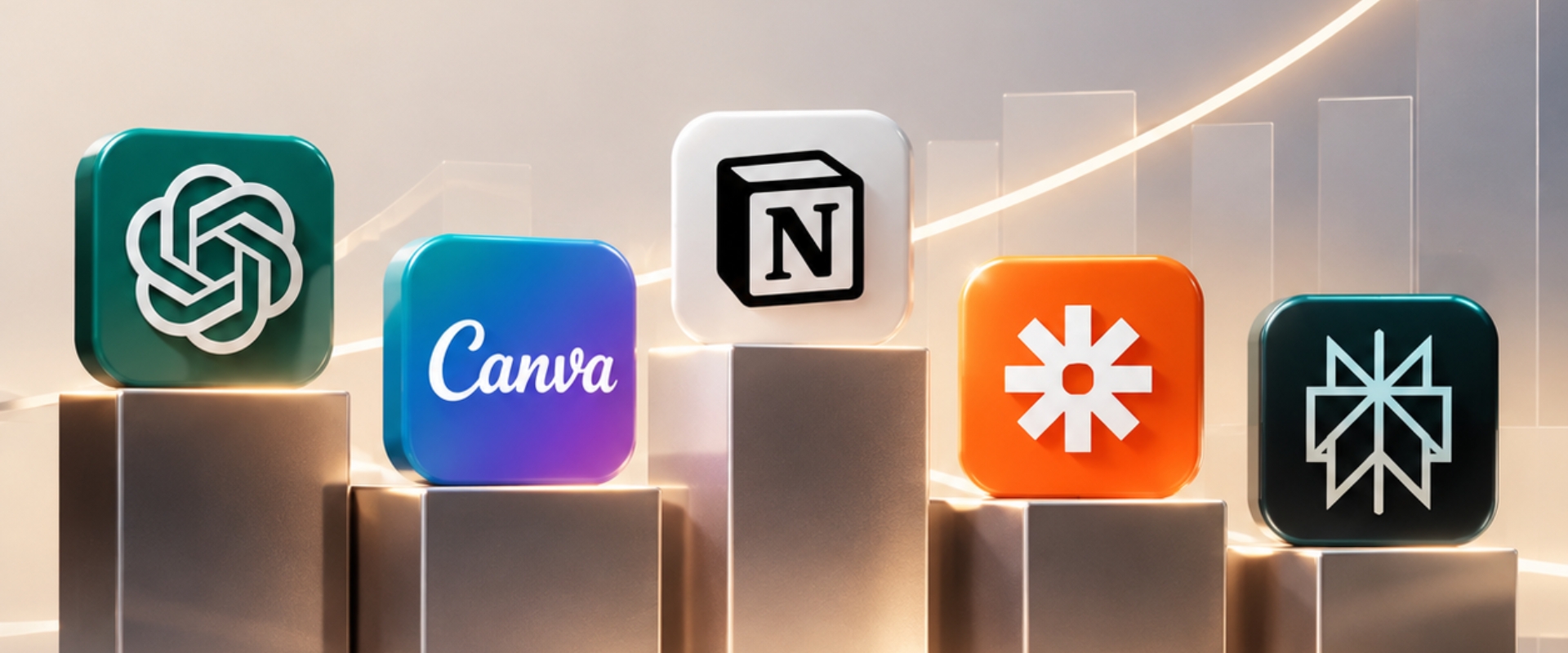
08 Ott 5 AI Tools | That Can Transform Your Business
How artificial intelligence is reshaping productivity, creativity, and the way we work.
Artificial intelligence is no longer just a glimpse into the future, it is already changing the way businesses operate, communicate, and grow.
From creating content and analyzing information to automating everyday tasks, AI is becoming an increasingly valuable resource for companies of every size.
But with hundreds of platforms available, one question remains: which AI tools can actually make a difference for your business?
The answer isn’t necessarily about choosing the most advanced technology. It’s about finding the right tools to simplify processes, unlock creativity, and make better use of your time.
Here are five AI powered platforms worth exploring.
1. ChatGPT – Your Everyday Business Assistant
Category: Productivity, Content & Strategy
When it comes to artificial intelligence, ChatGPT is probably one of the first names that comes to mind. But its potential goes far beyond answering questions.
For businesses, ChatGPT can act as a versatile assistant across multiple departments, supporting everything from marketing strategies and content creation to research, brainstorming, and data analysis.
Need to develop a communication campaign? Structure a business proposal? Analyze a spreadsheet or organize ideas for a new project?
ChatGPT can help turn complex tasks into more manageable processes, allowing teams to focus on what matters most.
The business advantage: Less time spent on repetitive tasks and more opportunities to concentrate on strategy, creativity, and decision making.
Website: chatgpt.com
2. Canva Magic Studio – Creativity Made Smarter
Category: Design, Branding & Marketing
Visual communication has become an essential part of almost every business. Social media content, presentations, advertising campaigns, and branded materials all require a consistent and recognizable identity.
Canva Magic Studio brings artificial intelligence directly into the creative process.
With AI powered design tools, businesses can generate visual concepts, create presentations, develop marketing materials, and adapt content to different formats more efficiently.
For small businesses and marketing teams, this means being able to transform an initial idea into visual content without always starting from a blank page.
Of course, AI doesn’t replace the expertise of a designer or the importance of a strong brand identity. Instead, it can accelerate the creative workflow and make experimentation easier.
The business advantage: Faster content production, greater creative flexibility, and more efficient visual communication.
Website: canva.com
3. Notion AI — A Smarter Way to Stay Organized
As businesses grow, keeping everything organized can become a challenge.
Projects, documents, meeting notes, deadlines, and internal information often end up scattered across different platforms.
Notion AI approaches this problem by combining workspace organization with artificial intelligence.
Teams can use it to summarize information, develop documents, retrieve knowledge, and manage project related content within a structured environment.
Imagine preparing for a meeting and being able to quickly find relevant project details, summarize previous discussions, and identify the next steps without manually reviewing every document.
For companies managing several projects simultaneously, having information organized and accessible can make a significant difference.
The business advantage: Clearer workflows, easier collaboration, and less time wasted searching for information.
Website: notion.com
4. Zapier — Let Automation Do the Repetitive Work
Not every business challenge requires a revolutionary idea. Sometimes, improving efficiency simply means eliminating repetitive tasks.
That’s where Zapier comes in.
The platform allows businesses to connect different applications and automate workflows, while its AI capabilities can help process information and perform more sophisticated actions.
For example, when a potential customer submits a contact form, an automated workflow could add their information to a CRM, notify the sales team, and prepare the next steps.
Similar processes can be created for internal operations, customer requests, reporting, and information management.
The objective isn’t to remove people from the process, but to reduce unnecessary manual work.
The business advantage: Smoother operations, fewer repetitive actions, and more time available for activities that require human judgment.
Website: zapier.com
5. Perplexity — Research That Goes Beyond a Search Engine
Every important business decision begins with information.
Understanding competitors, exploring market trends, discovering new opportunities, and staying informed are fundamental activities for companies that want to remain competitive.
Perplexity combines AI powered answers with web research, providing information supported by linked sources that users can explore and verify.
Instead of navigating through dozens of search results, professionals can begin with a focused question and progressively investigate the topic.
For example, a business planning to enter a new market could use Perplexity to explore industry developments, identify competitors, and gather initial insights before conducting deeper research.
It doesn’t eliminate the need to verify information, but it can make the research process considerably more efficient.
The business advantage: Faster access to relevant information, more structured research, and stronger starting points for strategic decisions.
Website: perplexity.ai
The Real Value of AI Isn’t the Technology, it’s How You Use It.
Artificial intelligence is changing the business landscape, but adopting new tools doesn’t automatically create better results.
A company with five different AI subscriptions isn’t necessarily more innovative than one using a single platform effectively.
The difference lies in understanding where technology can genuinely improve the way people work.
AI can accelerate processes, support creativity, simplify research, and reduce operational complexity. But strategy, intuition, experience, and human relationships remain essential.
For businesses looking to integrate AI into their daily operations, the smartest approach is often the simplest: identify a real challenge, choose the right tool, and measure the improvement.
Because the future of business isn’t just about working with artificial intelligence.
It’s about combining human creativity with the possibilities of technology.
And perhaps the biggest opportunity isn’t doing more work. It’s creating more value with the time we already have.

No Comments